
AI is becoming remarkably capable.
It can write reports, summarize meetings, analyze large amounts of data, generate content, identify patterns, answer customer questions, and increasingly, take actions on behalf of people.
For businesses, the potential is obvious: faster processes, lower operational effort, better access to information, and more opportunities to automate repetitive work.
But there is an important question that businesses should ask before handing more responsibility to AI:
Just because AI can do something, does that mean it should do it without supervision?
The answer is not necessarily.
AI can accelerate a business. It can help people make better decisions. It can even automate entire parts of a workflow.
But businesses still need to decide where AI should act independently, where it should ask for approval, and where human judgment must remain involved.
The goal isn't to slow AI down.
The goal is to make sure that automation doesn't run faster than the business can control it.
AI Is Powerful — But It Doesn't Automatically Understand Your Business
One of AI's greatest strengths is also one of its limitations.
AI can process information extremely quickly. Given enough data and the right instructions, it can identify patterns and generate recommendations that would take a human considerably longer to produce.
However, an AI system does not automatically understand the full context behind a business decision.
Consider a simple example.
An AI-powered system notices that a particular product has unusually low inventory and recommends ordering 5,000 additional units.
From the available data, the recommendation may look perfectly reasonable.
But what if the company is planning to discontinue that product next month?
Or what if a major customer has already cancelled an upcoming order?
Or perhaps the product is seasonal and the apparent inventory shortage is temporary.
The AI may be able to identify the pattern.
The business still needs to understand the context.
This distinction becomes increasingly important as businesses move from AI that simply generates information toward AI that can recommend or execute actions.
The Benefits of AI Are Real
This doesn't mean businesses should be cautious about AI to the point of avoiding it.
Quite the opposite.
Used appropriately, AI can provide significant value.
Speed
AI can process and summarize large amounts of information much faster than a person working manually.
Consistency
For repetitive tasks, AI can help apply the same process repeatedly, reducing some forms of manual inconsistency.
Pattern Recognition
AI can identify unusual patterns, relationships, and potential anomalies across large datasets.
Scalability
AI can support growing volumes of work without requiring every additional task to be handled manually.
Decision Support
AI can provide recommendations, summaries, scenarios, and insights that help people make decisions faster.
These capabilities make AI particularly attractive for areas such as customer service, reporting, document processing, data analysis, forecasting, and business operations.
The challenge isn't whether AI can provide value.
It clearly can.
The challenge is determining how much responsibility should be given to it.
The Risk of Letting AI Run on Autopilot
The biggest risk isn't necessarily that AI will make a mistake.
AI systems can make mistakes, generate incorrect information, misunderstand context, or produce recommendations based on incomplete data.
The bigger risk is creating a process where nobody is checking whether those mistakes matter.
Imagine a workflow like this:
AI → Decision → Action
It's fast.
But what happens when the AI makes an incorrect assumption?
A more controlled workflow might look like:
AI → Recommendation → Validation → Action
And for higher-risk processes:
AI → Recommendation → Human Review → Approval → Action
This doesn't mean every AI-generated email needs a manager's approval.
It means the level of oversight should match the potential impact of the decision.
A low-risk task can often be highly automated.
A high-impact financial, operational, legal, or customer-facing decision may require additional validation.
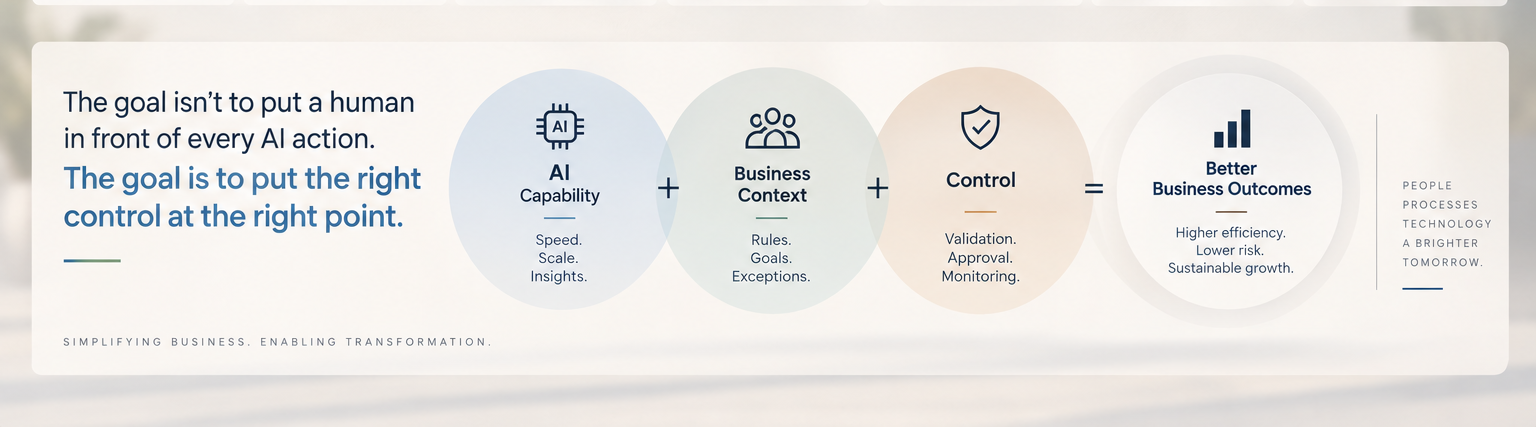
The objective isn't to put a human in front of every AI action.
The objective is to put the right control at the right point.
A Real-World Example: Air Canada's Chatbot
This isn't just a theoretical concern.
In 2024, Air Canada faced a case involving its AI-powered customer-service chatbot.
A passenger asked the chatbot about the airline's bereavement fare policy. The chatbot provided incorrect information suggesting that the passenger could obtain a bereavement fare adjustment after purchasing the ticket.
The airline later acknowledged that the chatbot's information was misleading.
The passenger brought the matter to Canada's Civil Resolution Tribunal, which ultimately found Air Canada liable for the chatbot's representation and ordered compensation.
The important lesson isn't simply that "AI made a mistake."
The more important lesson is that the business remained responsible for what its AI system communicated to customers.
From a customer's perspective, the chatbot was not an independent company.
It was part of Air Canada's customer experience.
This illustrates an important principle for businesses adopting AI:
Automating a business process does not automatically transfer responsibility to the AI.
If an AI system represents your company, makes recommendations within your operations, or takes actions on your behalf, the organization still needs appropriate controls around how that system operates.
Not Every AI Task Needs the Same Level of Control
One common mistake is thinking about AI oversight as an all-or-nothing decision.
It doesn't have to be.
Different tasks can require different levels of supervision.
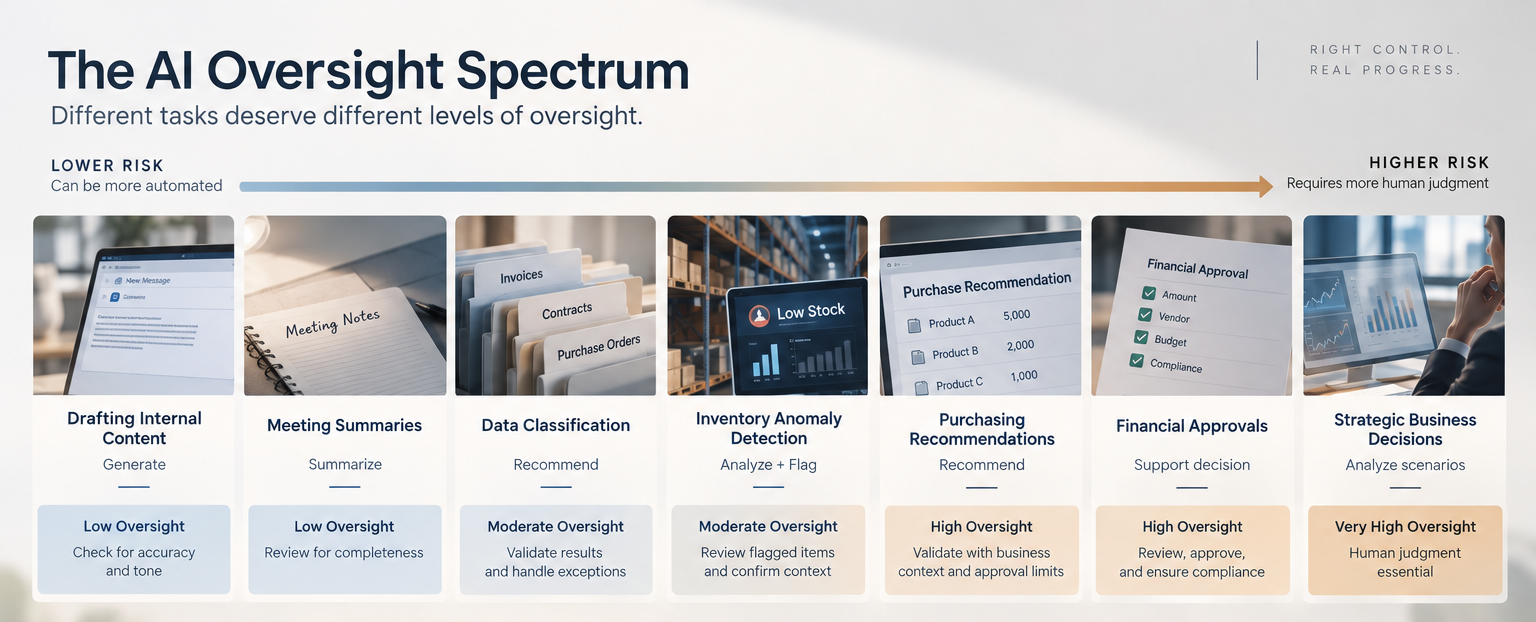
The exact level of control will depend on the organization, industry, process, and potential consequences.
For example, an AI assistant preparing a first draft of an internal report may require little oversight.
An AI system recommending a large financial transaction should be treated very differently.
This is consistent with the broader risk-management approach promoted by the U.S. National Institute of Standards and Technology (NIST), whose AI Risk Management Framework emphasizes managing AI risks through functions including Govern, Map, Measure, and Manage.
In other words, responsible AI isn't simply about asking:
"Can we automate this?"
It is also about asking:
"What could happen if the system gets it wrong?"
AI + Business Context + Control
For businesses, a practical approach can be built around three elements:
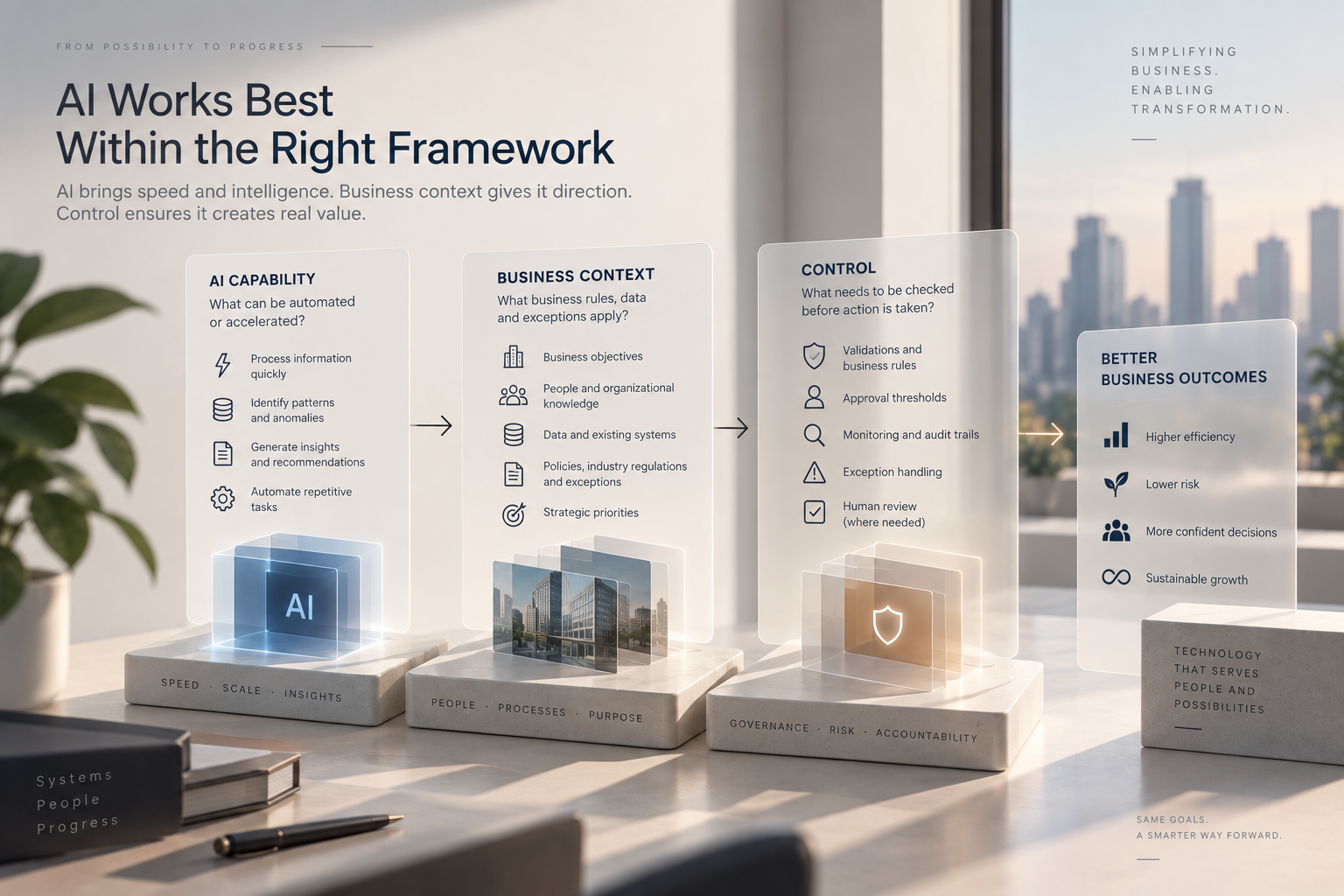
1. AI Capability
Identify what AI can realistically improve.
Can it reduce repetitive work?
Can it process information faster?
Can it identify anomalies?
Can it support employees with better information?
2. Business Context
Define what the AI needs to understand before making a recommendation or taking action.
What business rules apply?
What exceptions exist?
What information might be missing?
What decisions require organizational knowledge?
3. Control
Determine what needs to happen before an AI-generated recommendation becomes a real business action.
This could include:
- automated validation
- business rules
- approval thresholds
- exception handling
- audit trails
- monitoring
- human review
Together, these create a more practical model:
AI Capability
↓
Business Context
↓
Rules & Validation
↓
Human Judgment Where Needed
↓
Business Action
This approach allows businesses to benefit from automation without assuming that every AI output should automatically become a decision.
The Goal Isn't Less AI. It's Better AI Adoption.
AI adoption doesn't need to mean handing over control.
In fact, the most effective implementations may be the ones where AI and people have clearly defined roles.
AI can handle what it does best:
Process. Analyze. Identify. Recommend. Automate.
People can focus on what requires:
Context. Judgment. Accountability. Strategy.
This creates a different way of thinking about automation.
Instead of asking:
"How much of this process can we give to AI?"
Businesses can ask:
"Which parts of this process should AI handle, and where should people remain in control?"
That is a much more useful question.
AI Should Accelerate Decisions — Not Remove Responsibility
AI is likely to become an increasingly important part of how businesses operate.
The technology will continue to improve. AI agents will become more capable. More systems will be able to interact with business applications, analyze information, and take actions with less direct human input.
That makes thoughtful implementation even more important.
The future of business automation isn't necessarily a world where humans disappear from the process.
It may instead be a world where people spend less time performing repetitive work and more time providing the context, judgment, and accountability that machines cannot reliably provide on their own.
AI doesn't need to replace human decision-making to create enormous value.
Sometimes, its greatest value is helping people make better decisions, faster.
The objective isn't to give AI complete control.
It's to give AI the right amount of responsibility — with the right amount of control.
At SDN, We Believe Technology Should Simplify Business — Not Complicate Responsibility
AI can simplify processes, accelerate operations, and help businesses make better use of their data.
But successful transformation requires more than introducing new technology.
It requires understanding the business process behind it, identifying where automation creates value, and designing the right balance between technology, rules, and human judgment.
At SDN, we help businesses simplify operations, connect systems, and build practical technology solutions that support better decisions — while keeping business context and accountability at the center.
Simplifying Business. Enabling Transformation.
## References
Moffatt v. Air Canada, 2024 BCCRT 149. Civil Resolution Tribunal decision via CanLII
Tabassi, E., Artificial Intelligence Risk Management Framework (AI RMF 1.0), NIST AI 100-1, 2023. NIST publication
National Institute of Standards and Technology, Artificial Intelligence Risk Management Framework: Generative Artificial Intelligence Profile, NIST AI 600-1, 2024. NIST GenAI Profile